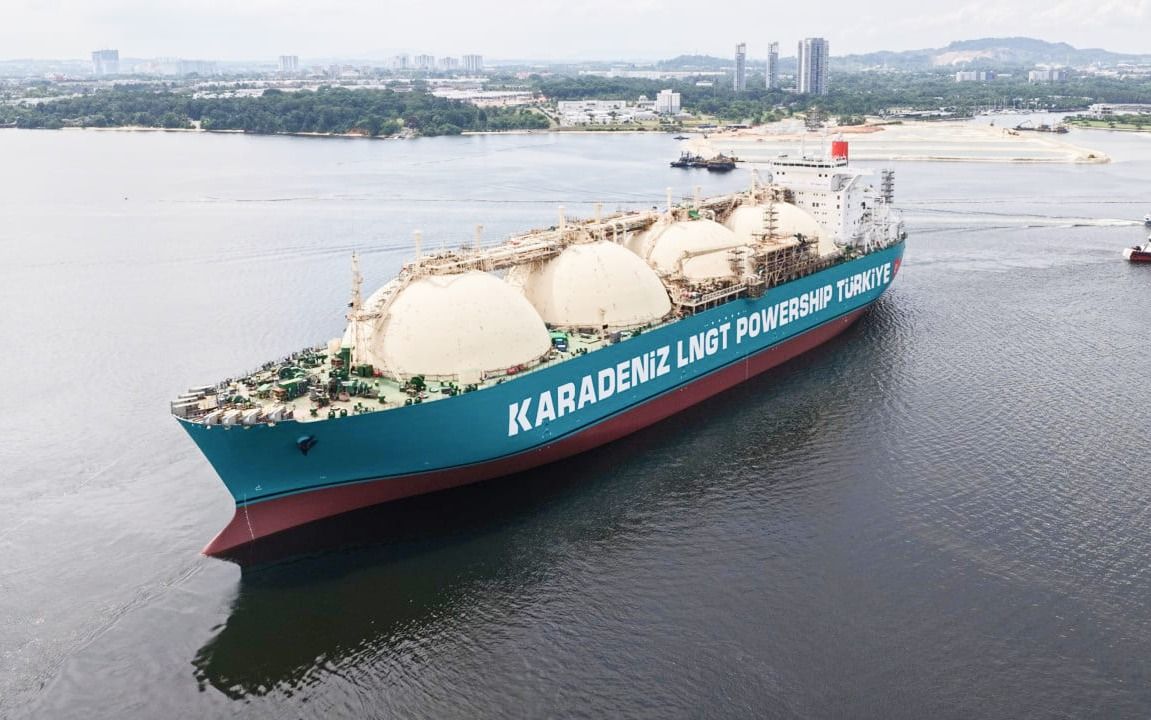
GAZ-SYSTEM has completed the driving of over 500 piles forming the foundation of the jetty for the FSRU terminal in Gulf of Gdańsk, in accordance with the approved schedule, on time, and on budget. This milestone marks a key phase in the project, bringing Poland one step closer to welcoming the first FSRU vessel and launching the second LNG terminal at the Polish coast.
“Developing LNG infrastructure directly strengthens Poland by securing its energy supply, boosting the economy, and upgrading the country’s position across Europe. The FSRU terminal in Gdańsk will increase our capacity to import natural gas from global markets and bolster Poland’s role in the regional supply system. This project is of particular importance considering ongoing geopolitical tensions and the evolving dynamics of the energy landscape. The significance of strategic investment projects extends beyond the energy sector itself – they also provide a boost to Polish businesses, harness domestic expertise and lay the foundations for stable development conditions for industry and the economy as a whole,” commented Miłosz Motyka, Minister for Energy.
“The completion of pile driving operation for the jetty in the FSRU terminal in Gdańsk marks another step towards the commissioning of a new gas supply facility in Poland. This initiative will effectively increase our gas import capacity by sea, reinforce supply diversification, and create additional opportunities for adaptable response to domestic energy demand. We remain committed to delivering investment projects that enhance the resilience and competitiveness of the Polish economy, thereby reinforcing our energy independence,” added Wojciech Wrochna, Secretary of State at the Ministry of Energy and the Government Plenipotentiary for Strategic Energy Infrastructure.
“We have just completed a critical and highly challenging phase of the project. We faced difficult conditions and changeable weather conditions. Nevertheless, owing to the determination of the contractors and meticulous coordination of the works, we have reached this critical milestone within the planned timeline. Now, the Terminal features a robust physical foundation. Next, we will be assembling the platforms and preparing for the construction of the subsea gas pipeline,” said Sławomir Hinc, President of GAZ-SYSTEM.
The installed piles form the basis of the jetty structure. They will support the platforms and enable the installation of all the equipment and systems necessary to operate the FSRU vessels.
The construction of the offshore section of the project involves the Consortium of companies including FABE Polska.
“The steel piles driven into the seabed of the Gulf of Gdańsk form the foundation of the structure on which the prefabricated jetty platforms will be mounted along with necessary equipment. Concurrently, a microtunnel spanning over one kilometre was completed, designed for the installation of the gas pipeline connecting the offshore facility to the onshore system. The greatest challenge was the seamless coordination of all operation components in one place and at one time; the delivery of materials, the availability of vessels and specialist equipment, and the work of teams at sea and on land. It was precisely this highly efficient logistical framework that enabled us to incorporate engineering solutions into timely project delivery,” remarked Łukasz Radomski, Deputy Contract Director at GAP–FABE–UNITEK Consortium.
In parallel with the jetty construction, operations continue to integrate the offshore and onshore parts of the facility. August 2026 marked the successful drilling of a microtunnel over 1 km in length, routed under the forest, dunes, and beach in Górki Zachodnie. A specialised tunnel boring machine (TBM) which remained beneath the Baltic Sea seabed following the drilling operation was used for the construction. Preparations are now in progress to facilitate its retrieval. Gas pipeline will be laid inside the tunnel connecting the terminal to the onshore part of the facility.
Work on the onshore section is also well advanced. In September, the Gdańsk-Gustorzyn gas pipeline successfully underwent tests using intelligent pig, which confirmed high standard of work and the pipeline’s good working order.
Meanwhile, works are underway to complete the outfitting of the FSRU at the South Korean shipyard in Ulsan. Its commissioning is scheduled in early 2028. Following regasification process, natural gas from the Solidarity vessel will be delivered to customers.
The FSRU programme is a strategic project aimed at strengthening Poland’s energy security. Owing to that programme, Poland is to gain an additional entry point for natural gas, thereby increasing the diversification of supplies and system robustness. The FSRU terminal is designed to enable the offloading of LNG delivered by sea, its regasification, and subsequent in-process storage.
In the onshore section of the FSRU programme, Polish companies are involved in 97% of the contracts totalling approximately PLN 1.8 billion, while delivering 72% of the offshore work scope. In the construction of the onshore section of the FSRU programme alone, Polish companies Izostal and Ferrum supplied 100%, i.e. approximately 254 km of steel pipes, while the total value of the 14 contracts awarded to them amounted to approximately PLN 600 million.